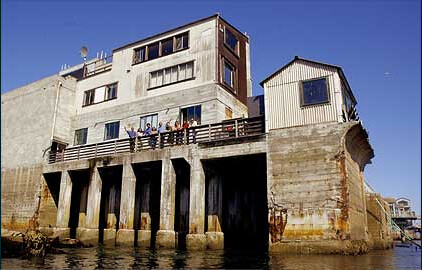
July 24, 2007. Swakopmund, Walvis Bay, Namibia.
With the list of filming ingredients whirling around in my head, a plan started to form.
1. Bronwen is the lighthouse. Like a sentry, sitting on the edge of the desert, looking out to sea in Swakopmund, there is an old lighthouse. As the sun sets everyday, the beam of the lighthouse cuts across the town. The lighthouse, like Bronwen, is forever vigilant keeping its eye on the ocean. I thought that we could meet Bronwen at night, as the fog sets in, follow her up the lighthouse stairs, and stand with her hundreds of feet above the city as her face is awash in the harsh glow of the revolving beam. From here, we can set up the story and the mystery of the fish explosions.
Great idea! Okay . . . how do we get in the lighthouse? Brook, Richard and Kathy were on the case.
2. Since so much of the story takes places within the minds of our three main characters -- Scarla, Andy, and Bronwen -- and since these characters were part of a vanguard of research, maybe we can create a space in the desert that both represents their pioneering efforts and captures the imaginative nature of their enterprise. The idea: whenever either of our scientists were getting deep into their research, they would be transported via a wash of white light into their thought space -- the vast desert.
Sounded cool and plausible, but we were running out of time. Can we create offices spaces in the Namibian desert? Where can we get desks, chairs, other office supplies to shoot the next day? This might not sound like a tall order, but consider this: after days of trying Brook couldn't find a rental car; there is one wireless Internet location in the country, according to Richard; and every store closes exactly at five o'clock.
3. After more conversations with George our guide (and explosives expert) at Tuna Corp, it becomes clear that we could probably pull off about three or four good explosions if we're lucky. George has all the right permits in place. And his license is good for a few more days!
With the potential of explosions becoming more real, I began formulating a plan on how we might use them. For our story, here's the challenge: The hydrogen sulfide explosions are extremely dangerous to life in the ocean. Hydrogen sulfide acts as a poison, and the explosions also remove oxygen from the water, suffocating sea life. The problem is that you can't film these events.
The concept: Our idea was to take Andy into the desert, which will have been established as a thinking space for our main characters, and as he walks the dunes contemplating the destructive force of the hydrogen sulfide events, he will pass through a series of frames where violent explosions erupt on cue.
This could be extremely effective, and very visual, but would it work? Could you get the explosives to fire? Would they fire on cue? How can we make sure that nobody gets hurt?

The lighthouse at Swakopmund, Namibia. Just as in Strange Days One, where we found ourselves saying "Think David Lynch not David Attenborough," in Swakopmund I kept repeating to myself, "Bronwen is the lighthouse."
 When Bronwen first arrived at the Ministry of Fisheries, her career path was clearly charted . . .
  . . . she set out to study the near shore ecosystem, with a singular focus . . .
  . . . but soon after her arrival, when she first learned of the hydrogen sulfide explosions, she veered off her immediate course, took a road less traveled and helped to address a mystery that many suspect needs to be considered in fisheries management -- the sulfide eruptions.