Showing posts with label explosives. Show all posts

Monday, August 6, 2007

Explosions

July 28, 2007. The desert outside Swakopmund, Nambia.

After much anticipation, we arrive early in the morning, before the easterly winds, eager to see if our explosives expert George will deliver. As he sets his powder and fuses and pours gallons of petrol, we set our shots, sit back and wait. There's a lot riding on these explosions, and I'm starting to feel the pressure. We've carved precious time out of a very tight schedule and if it doesn't work, we're going to be in trouble. George has brought enough powder, fuses and fuel to detonate five explosions. He's not sure exactly how big they will be, despite the fact that he's carefully measured and built each unit. Explosive can be unpredictable, and if the winds suddenly pick up they could blow fire, dust and rock in our direction. The unpredictability of explosives is real, and the fact that George is missing one hand underscores this fact. After decades of defusing bombs and creating explosive events for movies and concerts, it was a simple flare that blew up as he was holding it, taking his hand.

We decide to set-off a test explosion to gauge its size. We all take our position at a distance, and George counts down. "Three . . . two, one!"

A fireball races into the sky, followed by clouds of billowing smoke and great cheers. We're in business!

Chad, David, Chris, and Mark await the test fire.

Andy, our character can be seen walking in the desert contemplating the destructive nature of hydrogen sulfide events, as an explosion, shot in slow motions, blazes across the sky.

Chad stands next to the explosives so that we can mark the next shot.

The Plan

July 24, 2007. Swakopmund, Walvis Bay, Namibia.

With the list of filming ingredients whirling around in my head, a plan started to form.

1. Bronwen is the lighthouse. Like a sentry, sitting on the edge of the desert, looking out to sea in Swakopmund, there is an old lighthouse. As the sun sets everyday, the beam of the lighthouse cuts across the town. The lighthouse, like Bronwen, is forever vigilant keeping its eye on the ocean. I thought that we could meet Bronwen at night, as the fog sets in, follow her up the lighthouse stairs, and stand with her hundreds of feet above the city as her face is awash in the harsh glow of the revolving beam. From here, we can set up the story and the mystery of the fish explosions.

Great idea! Okay . . . how do we get in the lighthouse? Brook, Richard and Kathy were on the case.

2. Since so much of the story takes places within the minds of our three main characters -- Scarla, Andy, and Bronwen -- and since these characters were part of a vanguard of research, maybe we can create a space in the desert that both represents their pioneering efforts and captures the imaginative nature of their enterprise. The idea: whenever either of our scientists were getting deep into their research, they would be transported via a wash of white light into their thought space -- the vast desert.

Sounded cool and plausible, but we were running out of time. Can we create offices spaces in the Namibian desert? Where can we get desks, chairs, other office supplies to shoot the next day? This might not sound like a tall order, but consider this: after days of trying Brook couldn't find a rental car; there is one wireless Internet location in the country, according to Richard; and every store closes exactly at five o'clock.

3. After more conversations with George our guide (and explosives expert) at Tuna Corp, it becomes clear that we could probably pull off about three or four good explosions if we're lucky. George has all the right permits in place. And his license is good for a few more days!

With the potential of explosions becoming more real, I began formulating a plan on how we might use them. For our story, here's the challenge: The hydrogen sulfide explosions are extremely dangerous to life in the ocean. Hydrogen sulfide acts as a poison, and the explosions also remove oxygen from the water, suffocating sea life. The problem is that you can't film these events.

The concept: Our idea was to take Andy into the desert, which will have been established as a thinking space for our main characters, and as he walks the dunes contemplating the destructive force of the hydrogen sulfide events, he will pass through a series of frames where violent explosions erupt on cue.

This could be extremely effective, and very visual, but would it work? Could you get the explosives to fire? Would they fire on cue? How can we make sure that nobody gets hurt?

The lighthouse at Swakopmund, Namibia. Just as in Strange Days One, where we found ourselves saying "Think David Lynch not David Attenborough," in Swakopmund I kept repeating to myself, "Bronwen is the lighthouse."

Did You Say Explosives?

July 24, 2007. Swakopmund and Walvis Bay, Namibia.

Of all the stories that I've shot in my career, I've felt for a long time that this particular story was going to be a creative test -- and not just for me, but for the entire crew. The story itself is extremely compelling: explosions of hydrogen sulfide off the coast of Namibia have been killing ten's of thousands of fish. The mystery: how big are the explosions, what's causing them and what can be done -- if anything -- to lessen the impact?

The problem: There's very little that we can actually shoot. We don't have the time or money to wait for such an event to occur and most of the action, the sleuthing, takes place in minds of the scientists.

During the morning of our scout, we were guided by Kathy who lead us through the Ministry Building in a search for possible locations. The offices and the building were handsome and perched on the edge of the sea, but we'd traveled the whole way to Namibia, and shooting indoors just didn't seem right. Guided by our Production Assistant, Richard Berkley, we headed first to the desert and then on to Walvis Bay to continue our scout.

In the desert, Richard identified a number of locations, one of which might serve for a sequence when our scientists were considering the role of the desert in the story of explosive events. The desert was very impressive, and I began thinking that perhaps this location could play a bigger role in our story. As a location it was very cinematic but how could we use it . . . that was the question?

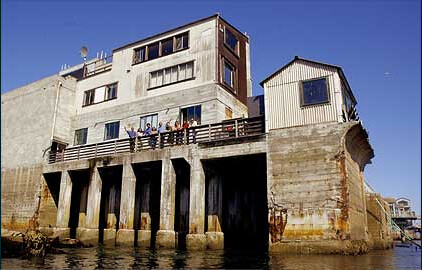
Next we headed off to Walvis Bay to scout possible warehouse locations at a place called Tuna Corp. In pictures that Richard sent to us, Tuna Corp's warehouses exuded a certain ambiance that might lend itself well to a series of sequences where our scientists were discussing potential scenarios that could explain the explosions in Namibia's waters. At Tuna Corp, we were met by George Pkuhn, who was going to guide us through the facility. Within a few short minutes of our tour, George mentioned that he was in the film business, too. I've heard this line a number of times, and I politely asked what he did. As George began speaking, I stopped dead.

"Did you say explosives?" I asked.
"Yes," George said. "I rig explosives for concerts and movies."
"What kind of explosives? Could you rig something pretty big with a lot of fire?"
"Sure, sure. That's what I do."
As we toured the warehouses at Tuna Corp, which proved to be very photogenic, I continued to question George about the possibility of rigging some explosives for us. I wasn't sure how I would use them, but if we could get explosives, I was sure that I could come up with something that would make sense.

As we left Tuna Corp, things were starting to come together. The ingredients:
1. A cool desert with amazing sand dunes
2. Railroad tracks that bisected part of the desert.
3. The potential of explosives.
4. Several empty warehouses with great lights and shadows.

How could these ingredients be used?

George Pkuhn is an explosive expert with decades of experience. The fact that George was missing one hand, and that we were going to try to put explosive into the film within a few short days, unnerved some of the crew just a little.

Chad, our assistant cameraman walks the desert . . .

. . . and his own sense of internal coolness . . .

. . . keeps him quite comfortable.