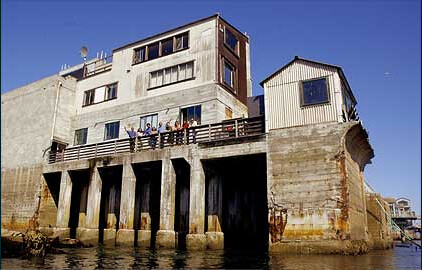
The Plastic Pollution Coalition invites you to
a special film screening
Friday, October 23, 2009
7 p.m. - 10:30 p.m.
UCLA Melnitz Hall - James Bridges Theater
See Tapped, the Movie www.tappedthemovie.com , followed by National Geographic's Strange Days on Planet Earth: Dirty Secrets, hosted by Edward Norton (http://www.pbs.org/strangedays), and a sneak preview of footage from a documentary by Bill Weaver and Jan Vozenilek on the current Midway Journey www.midwayjourney.com .
Screenings will be followed by a Q & A with the filmmakers.
Admission is free of charge
Get Informed. Take action.
This event is made possible through the generosity of Irmelin DiCaprio and the Leonardo DiCaprio Foundation, The UCLA School of Film, Television and Digital Media, and the UCLA Institute of the Environment, with additional support from the UCLA Education for Sustainable Living Program.
To reserve your seat(s) please RSVP to plasticpollution@gmail.com
Showing posts with label Strange Days on Planet Earth. Show all posts
Showing posts with label Strange Days on Planet Earth. Show all posts
Tuesday, September 29, 2009


Thursday, July 9, 2009
Think Beyond Plastics - a finalist at Jackson Hole Film Festival

Think Beyond Plastics is bubbling rapidly. After the film festival our ranks on Facebook are growing: Think Beyond Plastics as well as Don't Trash the Ocean have gained hundreds of new members.
But the most exciting news arrived today: Think Beyond Plastics is a finalist at the Best 360 Campaign Category at the Jackson Hole Film Festival. What a terrific recognition for the campaign, for the people who are working on it, and for all of our partners who have and continue to contribute efforts.
Thursday, May 1, 2008
Strange Days is all over youtube!
Hannah Smith Walker here...I am a production/post coordinator at Sea Studios. But I am also one of the team members helping Sea Studios enter Web 2.0. We started a youtube channel called StrangeDaysAction (www.youtube.com/StrangeDaysAction), and have posted many of our videos. But I just did a quick search on youtube and found lots of youtubers posting trailers of Strange Days, interviews and speeches with Norton about Strange Days, and actual pieces of the newest episodes that only aired last week.
Here's a couple examples of what I found posted:
Here's a couple examples of what I found posted:
Monday, April 28, 2008
Earthday
Earthday, Tuesday April 22. New York City.
It’s 7am and Edward has just arrived at the Today Show studio. We’re welcomed by a nice producer who prepped the interview. Edward is going to be able to talk about Strange Days and our campaign encouraging people to stop using plastic bags. He’s asked to hand out reusable bags to the crowd outside. Great that even the Today show is going green—at least for today. 7:40 and he’s taken to the “couch.” I’m invited along to watch from inside the studio. But today is no normal day. Mrs. Bush is a guest also. As a result, I’m not let in and watch on a monitor in the green room. The interview goes well. Matt Lauer seems to be a genuine fan. With a day to the broadcast, I hope that it will convince some folks to tune in. And who knows, it might even get some to think about their use of plastic.
I had to laugh. As I was hustling to the subway to catch my flight back home, I look up and spot “plastic man.” Here is this guy covered in plastic bags. I had to meet him and get his picture. He and his buddy are traveling the country on behalf of the environment. And plastic man is a Stanford grad. What a kick. I’ll find out more about what he’s up to and post it when I do.
--Mark Shelley
It’s 7am and Edward has just arrived at the Today Show studio. We’re welcomed by a nice producer who prepped the interview. Edward is going to be able to talk about Strange Days and our campaign encouraging people to stop using plastic bags. He’s asked to hand out reusable bags to the crowd outside. Great that even the Today show is going green—at least for today. 7:40 and he’s taken to the “couch.” I’m invited along to watch from inside the studio. But today is no normal day. Mrs. Bush is a guest also. As a result, I’m not let in and watch on a monitor in the green room. The interview goes well. Matt Lauer seems to be a genuine fan. With a day to the broadcast, I hope that it will convince some folks to tune in. And who knows, it might even get some to think about their use of plastic.
I had to laugh. As I was hustling to the subway to catch my flight back home, I look up and spot “plastic man.” Here is this guy covered in plastic bags. I had to meet him and get his picture. He and his buddy are traveling the country on behalf of the environment. And plastic man is a Stanford grad. What a kick. I’ll find out more about what he’s up to and post it when I do.
--Mark Shelley
Earthday Rally
Sunday April 20, Washington, D.C.
Woke up this morning and pulled open the shades… rain. Hard rain. My fantasy of being involved in the latest of a great tradition of historic events that have taken place on the Mall-- Viet Nam war rallies, Martin Luther King, the Million Man March-- dissolved into scenes from Woodstock. Well, if we’re celebrating nature, what better way than for her to show us what she’s got. Norton’s psyched, though. Spirits are still high. We have the chance to introduce our Bag the Bag video to the hearty soles who won’t be discouraged by a little… torrential downpour.
After a short delay for a thunderstorm to pass, the rally gets going again and the giant Jumbotron’s light up with our video. The loudest cheers of the day emerge from under thousands of umbrellas when he says “paper or plastic? How about neither.” No question he speaks to this crowd. Edward is then introduced. And he’s on fire. For 5 minutes he made getting involved with environmental issues hip, relevant, and the most important challenge of our time--. It reminded me of the first Earthday rally in San Francisco. I was lucky enough (and old enough) to have been there. Country Joe and the Fish; Crosby, Stills, and Nash, Joan Baez. It was a movement. There was passion, energy, urgency. And we-- all of us-- were going to change the world. And in many ways we did. For a moment, I thought that we just might be able to do it again. Edward finishes, the crowd erupts, and so does the sky. At one point I saw a lightning bolt hit the top of the Washington Monument. Solid water. Minutes later, the Park Service cancelled the rest of the show. But we made it and it was thrilling. I’m hoping to get a recording of his talk and will post it if we do. Check back.
--Mark Shelley
Woke up this morning and pulled open the shades… rain. Hard rain. My fantasy of being involved in the latest of a great tradition of historic events that have taken place on the Mall-- Viet Nam war rallies, Martin Luther King, the Million Man March-- dissolved into scenes from Woodstock. Well, if we’re celebrating nature, what better way than for her to show us what she’s got. Norton’s psyched, though. Spirits are still high. We have the chance to introduce our Bag the Bag video to the hearty soles who won’t be discouraged by a little… torrential downpour.
After a short delay for a thunderstorm to pass, the rally gets going again and the giant Jumbotron’s light up with our video. The loudest cheers of the day emerge from under thousands of umbrellas when he says “paper or plastic? How about neither.” No question he speaks to this crowd. Edward is then introduced. And he’s on fire. For 5 minutes he made getting involved with environmental issues hip, relevant, and the most important challenge of our time--. It reminded me of the first Earthday rally in San Francisco. I was lucky enough (and old enough) to have been there. Country Joe and the Fish; Crosby, Stills, and Nash, Joan Baez. It was a movement. There was passion, energy, urgency. And we-- all of us-- were going to change the world. And in many ways we did. For a moment, I thought that we just might be able to do it again. Edward finishes, the crowd erupts, and so does the sky. At one point I saw a lightning bolt hit the top of the Washington Monument. Solid water. Minutes later, the Park Service cancelled the rest of the show. But we made it and it was thrilling. I’m hoping to get a recording of his talk and will post it if we do. Check back.
--Mark Shelley
On the Way to Earthday
Heading out to DC for Earthday on the Nation’s Mall. We’re launching our Bag the Bag viral video campaign for reusable bags (saying no to paper AND plastic)-- www.thegreenguide.com/strangedays. It is also the final swing of promotion for the broadcast Wednesday night.
Interesting that Bisphenol A (BPA) is in the news right now.
This is a story we were picking up on over a year ago when we started research for Dirty Secrets. Today it is getting a lot of press because new studies with lab rats given BPA show changes suggesting a potential cancer risk and and could be involved with changes resulting in early puberty Polycarbonate is made with BPA.
This is one of those unnecessarily confusing issues for the public. A google search for BPA will result in a mixture of peer reviewed study references and industry disguised sites. A parent sorting through the sites finds comforting words telling you there is absolutely no health concern with using polycarbonates countered by scientists like the one we feature in Dirty Secrets, Dr. Frederick vom Saal, telling you that there is enough evidence to avoid the use.
To illustrate, check this out—go to Fox News and read the article, Coming Soon: More Chemical Scares Than Anyone Dreamed Possible by Steven Milloy, http://www.foxnews.com/story/0,2933,25065,00.html
The tag for the story is: Anti-chemical activists achieved a major victory this week. A government-sponsored panel of scientists laid the foundation for banning virtually any chemical on a whim.
“On a whim?” This is journalism? The article goes on to state: “[Activists’] claims are based in the work of Our Stolen Future cult leader and University of Missouri researcher Frederick vom Saal. His experiments on laboratory mice supposedly show that very low doses of some chemicals — thousands of times lower than current safe standards — increased prostate weight in male mice and advanced puberty in female mice.
Now go to an article at in the peer reviewed journal, PLoS Biology (from the Public Library of Science) by Liza Gross called, The Toxic Origins of Disease. http://biology.plosjournals.org/perlserv/?request=get-document&doi=10.1371/journal.pbio.0050193&ct=1&SESSID=b899536fe5b3780ff2782d723b0149a4
Her tag line: Researchers say endocrine-disrupting chemicals can permanently harm the developing organism and may even promote obesity. But the chemical industry doesn't want you to believe them.
What does a concerned person do—particularly if you don’t want to spend hours sorting through the controversy? You may want to look at what Canada is doing. Just last week, Canada banned the import and sale of plastic polycarbonate baby bottles. And Wal-Mart Canada is pulling baby bottles made with polycarbonate from its shelves. That’s enough for me, though I tend to adopt the precautionary principle on these issues—I had enough evidence sometime ago.
To help you—at least a little-- check out our Smart Plastics Guide at at http://www-tc.pbs.org/strangedays/pdf/StrangeDaysSmartPlasticsGuide.pdf
--Mark Shelley
Interesting that Bisphenol A (BPA) is in the news right now.
This is a story we were picking up on over a year ago when we started research for Dirty Secrets. Today it is getting a lot of press because new studies with lab rats given BPA show changes suggesting a potential cancer risk and and could be involved with changes resulting in early puberty Polycarbonate is made with BPA.
This is one of those unnecessarily confusing issues for the public. A google search for BPA will result in a mixture of peer reviewed study references and industry disguised sites. A parent sorting through the sites finds comforting words telling you there is absolutely no health concern with using polycarbonates countered by scientists like the one we feature in Dirty Secrets, Dr. Frederick vom Saal, telling you that there is enough evidence to avoid the use.
To illustrate, check this out—go to Fox News and read the article, Coming Soon: More Chemical Scares Than Anyone Dreamed Possible by Steven Milloy, http://www.foxnews.com/story/0,2933,25065,00.html
The tag for the story is: Anti-chemical activists achieved a major victory this week. A government-sponsored panel of scientists laid the foundation for banning virtually any chemical on a whim.
“On a whim?” This is journalism? The article goes on to state: “[Activists’] claims are based in the work of Our Stolen Future cult leader and University of Missouri researcher Frederick vom Saal. His experiments on laboratory mice supposedly show that very low doses of some chemicals — thousands of times lower than current safe standards — increased prostate weight in male mice and advanced puberty in female mice.
Now go to an article at in the peer reviewed journal, PLoS Biology (from the Public Library of Science) by Liza Gross called, The Toxic Origins of Disease. http://biology.plosjournals.org/perlserv/?request=get-document&doi=10.1371/journal.pbio.0050193&ct=1&SESSID=b899536fe5b3780ff2782d723b0149a4
Her tag line: Researchers say endocrine-disrupting chemicals can permanently harm the developing organism and may even promote obesity. But the chemical industry doesn't want you to believe them.
What does a concerned person do—particularly if you don’t want to spend hours sorting through the controversy? You may want to look at what Canada is doing. Just last week, Canada banned the import and sale of plastic polycarbonate baby bottles. And Wal-Mart Canada is pulling baby bottles made with polycarbonate from its shelves. That’s enough for me, though I tend to adopt the precautionary principle on these issues—I had enough evidence sometime ago.
To help you—at least a little-- check out our Smart Plastics Guide at at http://www-tc.pbs.org/strangedays/pdf/StrangeDaysSmartPlasticsGuide.pdf
--Mark Shelley
Wednesday, April 16, 2008
Exciting New Media at Sea Studios
Sea Studios has embraced Web 2.0! Please explore some of our new media ventures:
We have our very own YouTube Channel called Strange Days Action. Go to: www.youtube.com/strangedaysaction to see many of our films.
We have also started several social networking communities and causes on Facebook and Myspace. Please click on any of the following:
Strange Days Facebook Cause: Make Waves
MySpace Strange Days Action Cause
Wastephobia
Save the Coral Reef
Stop Trashing the Ocean: The Great Garbage Patch
We are involved in an online movement called Drop the Plastic Bag. Please visit: www.droptheplasticbag.org to join forums, to find resources, and to take a number of actions.
Go to the The Green Guide to see our "Bag the Bag" video, starring Edward Norton.
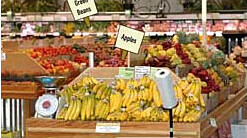
And finally, go shopping at our interactive supermarket. Go to: www.pbs.org/strangedays/getinvolved/
We have our very own YouTube Channel called Strange Days Action. Go to: www.youtube.com/strangedaysaction to see many of our films.
We have also started several social networking communities and causes on Facebook and Myspace. Please click on any of the following:
Strange Days Facebook Cause: Make Waves
MySpace Strange Days Action Cause
Wastephobia
Save the Coral Reef
Stop Trashing the Ocean: The Great Garbage Patch
We are involved in an online movement called Drop the Plastic Bag. Please visit: www.droptheplasticbag.org to join forums, to find resources, and to take a number of actions.
Go to the The Green Guide to see our "Bag the Bag" video, starring Edward Norton.
And finally, go shopping at our interactive supermarket. Go to: www.pbs.org/strangedays/getinvolved/
Television Premiere of Strange Days II

We are counting down the days to our broadcast premiere! Please join us by tuning in to PBS on April 23rd (Wednesday evening) to see "Dangerous Catch" and "Dirty Secrets".
Also check out our brand new interactive Strange Days PBS website: www.pbs.org/strangedays
Wednesday, January 30, 2008
Strange Days on Planet Earth Host Shoot


Well it finally happened...we filmed our host, Edward Norton in LA. We would have filmed him earlier in the month, but a freak storm put an end to that plan.
The second planned shoot went very smoothly. Our line producer, Brook Holston spent weeks working on the pre-production plans. We only had two days, but we managed to film all of the scenes starring Edward Norton for both new episodes of "Strange Days on Planet Earth". "Dirty Secrets" and "Dangerous Catch" will be premiering on PBS in April 2008 (the day after Earth Day).


This shoot was especially exciting for me because I was brought on as the still photographer. This was the first time I had been on a crew where it was my sole responsibility to take photos. Normally, I am a PA (production assistant), so my job usually consists of doing whatever anyone tells me. Plus, I always take photos anyway. But this time I had the pleasure of focusing on just the photography. Also, someone hooked me up with a headset so I could listen in to all the production-speak. I am a scientist and a photographer by background, so the whole LA film scene was new to me.
 We had a 40 person + film crew this time. There were assistants for the assistants! Everything had to be perfectly choreographed so that we could film Edward Norton at all of the correct locations in the perfect light. We shot at a pier, a culvert, a fish market, a parking lot, a beach, and a water treatment plant.


 Imagine getting that many people set up, tore down, and moved around in just two days. Kudos Brook!
Monday, August 6, 2007
The Big Think
July 28, 2007. Swakopmund, Namibia.
 In a warehouse we all gather to block out the sequence. In the sequence, Scarla, Andy and Bronwen would be discussing their theories as to what was causing the eruptions of hydrogen sulfide.
 Before shooting, Scarla, Andy and Bronwen take this opportunity to get some work done. In reality these three mostly collaborated virtually via e-mail and phone conversations. Given the chance to actually be in the same room, they never missed a moment when they could dive into their data and work face-to-face.
 In a warehouse we all gather to block out the sequence. In the sequence, Scarla, Andy and Bronwen would be discussing their theories as to what was causing the eruptions of hydrogen sulfide.
  Before shooting, Scarla, Andy and Bronwen take this opportunity to get some work done. In reality these three mostly collaborated virtually via e-mail and phone conversations. Given the chance to actually be in the same room, they never missed a moment when they could dive into their data and work face-to-face.
Welwitcha
July 27, 2007. Walvis Bay, Namibia.
 For days, Kathy Peeard has been making miracles happen. She got us permission to film at the lighthouse in Swakopmund. She helped us scout locations at the Ministry, ran interference, greased wheels and basically made all of our jobs that much easier. Kathy and Bronwen even helped to arrange a special expedition on the research vessel Welwitcha. This was a great treat for all of us. For Mark Knobil and me, the experience brought back memories of more than a decade ago when we both set sail (twice) to film at the Titanic in the Atlantic. For Brook, who had just finished producing a series of specials focused on ocean conservation, it was a welcome change to the driving, flying and hiking we'd been experiencing for nearly a month.
 The happy faces of Richard . . .
 . . . Brook. . .
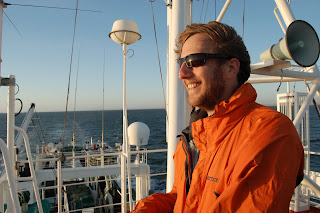 . . . Chad . . .
 . . . Chris . . .
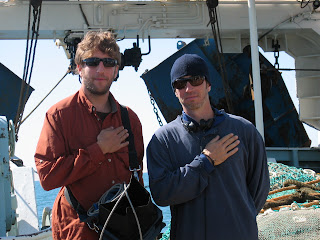 . . . Chad and David . . .
 . . . Mark and Chad. . .
It was great to be out at sea!
 For days, Kathy Peeard has been making miracles happen. She got us permission to film at the lighthouse in Swakopmund. She helped us scout locations at the Ministry, ran interference, greased wheels and basically made all of our jobs that much easier. Kathy and Bronwen even helped to arrange a special expedition on the research vessel Welwitcha. This was a great treat for all of us. For Mark Knobil and me, the experience brought back memories of more than a decade ago when we both set sail (twice) to film at the Titanic in the Atlantic. For Brook, who had just finished producing a series of specials focused on ocean conservation, it was a welcome change to the driving, flying and hiking we'd been experiencing for nearly a month.
 The happy faces of Richard . . .
  . . . Brook. . .
  . . . Chad . . .
  . . . Chris . . .
 . . . Chad and David . . .
  . . . Mark and Chad. . .
 It was great to be out at sea!
Explosions
July 28, 2007. The desert outside Swakopmund, Nambia.
After much anticipation, we arrive early in the morning, before the easterly winds, eager to see if our explosives expert George will deliver. As he sets his powder and fuses and pours gallons of petrol, we set our shots, sit back and wait. There's a lot riding on these explosions, and I'm starting to feel the pressure. We've carved precious time out of a very tight schedule and if it doesn't work, we're going to be in trouble. George has brought enough powder, fuses and fuel to detonate five explosions. He's not sure exactly how big they will be, despite the fact that he's carefully measured and built each unit. Explosive can be unpredictable, and if the winds suddenly pick up they could blow fire, dust and rock in our direction. The unpredictability of explosives is real, and the fact that George is missing one hand underscores this fact. After decades of defusing bombs and creating explosive events for movies and concerts, it was a simple flare that blew up as he was holding it, taking his hand.
We decide to set-off a test explosion to gauge its size. We all take our position at a distance, and George counts down. "Three . . . two, one!"
A fireball races into the sky, followed by clouds of billowing smoke and great cheers. We're in business!
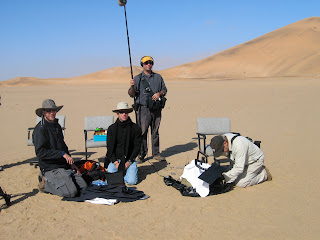 Chad, David, Chris, and Mark await the test fire.
 Andy, our character can be seen walking in the desert contemplating the destructive nature of hydrogen sulfide events, as an explosion, shot in slow motions, blazes across the sky.
 Chad stands next to the explosives so that we can mark the next shot.
After much anticipation, we arrive early in the morning, before the easterly winds, eager to see if our explosives expert George will deliver. As he sets his powder and fuses and pours gallons of petrol, we set our shots, sit back and wait. There's a lot riding on these explosions, and I'm starting to feel the pressure. We've carved precious time out of a very tight schedule and if it doesn't work, we're going to be in trouble. George has brought enough powder, fuses and fuel to detonate five explosions. He's not sure exactly how big they will be, despite the fact that he's carefully measured and built each unit. Explosive can be unpredictable, and if the winds suddenly pick up they could blow fire, dust and rock in our direction. The unpredictability of explosives is real, and the fact that George is missing one hand underscores this fact. After decades of defusing bombs and creating explosive events for movies and concerts, it was a simple flare that blew up as he was holding it, taking his hand.
We decide to set-off a test explosion to gauge its size. We all take our position at a distance, and George counts down. "Three . . . two, one!"
A fireball races into the sky, followed by clouds of billowing smoke and great cheers. We're in business!
 Chad, David, Chris, and Mark await the test fire.
 Andy, our character can be seen walking in the desert contemplating the destructive nature of hydrogen sulfide events, as an explosion, shot in slow motions, blazes across the sky.
 Chad stands next to the explosives so that we can mark the next shot.
Desert Offices
July 24, 2007. Desert outside of Swakopmund, Namibia.
 Chad moves some lamps that we borrow from the hotel.
 Chris positions a desk, racing the sun as the winds begin to pick up.
 The desk is leveled, stairs are built, and a chair is rigged so that it won't sink into the Namibian sand.
 Richard Berkely, our production assistant who performed the role of a coordinator with precision, sits in as we block out a shot.
 Chad moves some lamps that we borrow from the hotel.
 Chris positions a desk, racing the sun as the winds begin to pick up.
 The desk is leveled, stairs are built, and a chair is rigged so that it won't sink into the Namibian sand.
 Richard Berkely, our production assistant who performed the role of a coordinator with precision, sits in as we block out a shot.
Questions
July 24, 2007. Walvis Bay, Namibia.
 David Elisco (Vice President for Creative Affairs)
Lighthouses . . . explosions . . . offices in the desert . . . None of this was planned, or even contemplated until hours before we started to set the wheels in motion. The scientists -- Scarla, Andy, Bronwen, and Kathy -- were behind the plan. In fact they were cheering us on, having fun with the creative nature of our endeavor. Brook and Richard employed their laser focus to nail down all the details, pulling rabbits out of their hats, arranging and rearranging the schedule based on a myriad of criteria. Mark, Chris and Chad through their creative energy into the fire, fueling the process with unbridled optimism as only three guys from Pittsburgh can.
But still . . . would it all work? Would it be as visually appealing as we thought? Would it help to drive the story forward? I was confident, but uncertain and this uncertainty was further exacerbated by other more personal events that were simultaneously unfolding in my life.
 David Elisco (Vice President for Creative Affairs)
Lighthouses . . . explosions . . . offices in the desert . . . None of this was planned, or even contemplated until hours before we started to set the wheels in motion. The scientists -- Scarla, Andy, Bronwen, and Kathy -- were behind the plan. In fact they were cheering us on, having fun with the creative nature of our endeavor. Brook and Richard employed their laser focus to nail down all the details, pulling rabbits out of their hats, arranging and rearranging the schedule based on a myriad of criteria. Mark, Chris and Chad through their creative energy into the fire, fueling the process with unbridled optimism as only three guys from Pittsburgh can.
But still . . . would it all work? Would it be as visually appealing as we thought? Would it help to drive the story forward? I was confident, but uncertain and this uncertainty was further exacerbated by other more personal events that were simultaneously unfolding in my life.
The Plan
July 24, 2007. Swakopmund, Walvis Bay, Namibia.
With the list of filming ingredients whirling around in my head, a plan started to form.
1. Bronwen is the lighthouse. Like a sentry, sitting on the edge of the desert, looking out to sea in Swakopmund, there is an old lighthouse. As the sun sets everyday, the beam of the lighthouse cuts across the town. The lighthouse, like Bronwen, is forever vigilant keeping its eye on the ocean. I thought that we could meet Bronwen at night, as the fog sets in, follow her up the lighthouse stairs, and stand with her hundreds of feet above the city as her face is awash in the harsh glow of the revolving beam. From here, we can set up the story and the mystery of the fish explosions.
Great idea! Okay . . . how do we get in the lighthouse? Brook, Richard and Kathy were on the case.
2. Since so much of the story takes places within the minds of our three main characters -- Scarla, Andy, and Bronwen -- and since these characters were part of a vanguard of research, maybe we can create a space in the desert that both represents their pioneering efforts and captures the imaginative nature of their enterprise. The idea: whenever either of our scientists were getting deep into their research, they would be transported via a wash of white light into their thought space -- the vast desert.
Sounded cool and plausible, but we were running out of time. Can we create offices spaces in the Namibian desert? Where can we get desks, chairs, other office supplies to shoot the next day? This might not sound like a tall order, but consider this: after days of trying Brook couldn't find a rental car; there is one wireless Internet location in the country, according to Richard; and every store closes exactly at five o'clock.
3. After more conversations with George our guide (and explosives expert) at Tuna Corp, it becomes clear that we could probably pull off about three or four good explosions if we're lucky. George has all the right permits in place. And his license is good for a few more days!
With the potential of explosions becoming more real, I began formulating a plan on how we might use them. For our story, here's the challenge: The hydrogen sulfide explosions are extremely dangerous to life in the ocean. Hydrogen sulfide acts as a poison, and the explosions also remove oxygen from the water, suffocating sea life. The problem is that you can't film these events.
The concept: Our idea was to take Andy into the desert, which will have been established as a thinking space for our main characters, and as he walks the dunes contemplating the destructive force of the hydrogen sulfide events, he will pass through a series of frames where violent explosions erupt on cue.
This could be extremely effective, and very visual, but would it work? Could you get the explosives to fire? Would they fire on cue? How can we make sure that nobody gets hurt?
 The lighthouse at Swakopmund, Namibia. Just as in Strange Days One, where we found ourselves saying "Think David Lynch not David Attenborough," in Swakopmund I kept repeating to myself, "Bronwen is the lighthouse."
With the list of filming ingredients whirling around in my head, a plan started to form.
1. Bronwen is the lighthouse. Like a sentry, sitting on the edge of the desert, looking out to sea in Swakopmund, there is an old lighthouse. As the sun sets everyday, the beam of the lighthouse cuts across the town. The lighthouse, like Bronwen, is forever vigilant keeping its eye on the ocean. I thought that we could meet Bronwen at night, as the fog sets in, follow her up the lighthouse stairs, and stand with her hundreds of feet above the city as her face is awash in the harsh glow of the revolving beam. From here, we can set up the story and the mystery of the fish explosions.
Great idea! Okay . . . how do we get in the lighthouse? Brook, Richard and Kathy were on the case.
2. Since so much of the story takes places within the minds of our three main characters -- Scarla, Andy, and Bronwen -- and since these characters were part of a vanguard of research, maybe we can create a space in the desert that both represents their pioneering efforts and captures the imaginative nature of their enterprise. The idea: whenever either of our scientists were getting deep into their research, they would be transported via a wash of white light into their thought space -- the vast desert.
Sounded cool and plausible, but we were running out of time. Can we create offices spaces in the Namibian desert? Where can we get desks, chairs, other office supplies to shoot the next day? This might not sound like a tall order, but consider this: after days of trying Brook couldn't find a rental car; there is one wireless Internet location in the country, according to Richard; and every store closes exactly at five o'clock.
3. After more conversations with George our guide (and explosives expert) at Tuna Corp, it becomes clear that we could probably pull off about three or four good explosions if we're lucky. George has all the right permits in place. And his license is good for a few more days!
With the potential of explosions becoming more real, I began formulating a plan on how we might use them. For our story, here's the challenge: The hydrogen sulfide explosions are extremely dangerous to life in the ocean. Hydrogen sulfide acts as a poison, and the explosions also remove oxygen from the water, suffocating sea life. The problem is that you can't film these events.
The concept: Our idea was to take Andy into the desert, which will have been established as a thinking space for our main characters, and as he walks the dunes contemplating the destructive force of the hydrogen sulfide events, he will pass through a series of frames where violent explosions erupt on cue.
This could be extremely effective, and very visual, but would it work? Could you get the explosives to fire? Would they fire on cue? How can we make sure that nobody gets hurt?
The lighthouse at Swakopmund, Namibia. Just as in Strange Days One, where we found ourselves saying "Think David Lynch not David Attenborough," in Swakopmund I kept repeating to myself, "Bronwen is the lighthouse."
Did You Say Explosives?
July 24, 2007. Swakopmund and Walvis Bay, Namibia.
Of all the stories that I've shot in my career, I've felt for a long time that this particular story was going to be a creative test -- and not just for me, but for the entire crew. The story itself is extremely compelling: explosions of hydrogen sulfide off the coast of Namibia have been killing ten's of thousands of fish. The mystery: how big are the explosions, what's causing them and what can be done -- if anything -- to lessen the impact?
The problem: There's very little that we can actually shoot. We don't have the time or money to wait for such an event to occur and most of the action, the sleuthing, takes place in minds of the scientists.
During the morning of our scout, we were guided by Kathy who lead us through the Ministry Building in a search for possible locations. The offices and the building were handsome and perched on the edge of the sea, but we'd traveled the whole way to Namibia, and shooting indoors just didn't seem right. Guided by our Production Assistant, Richard Berkley, we headed first to the desert and then on to Walvis Bay to continue our scout.
In the desert, Richard identified a number of locations, one of which might serve for a sequence when our scientists were considering the role of the desert in the story of explosive events. The desert was very impressive, and I began thinking that perhaps this location could play a bigger role in our story. As a location it was very cinematic but how could we use it . . . that was the question?
Next we headed off to Walvis Bay to scout possible warehouse locations at a place called Tuna Corp. In pictures that Richard sent to us, Tuna Corp's warehouses exuded a certain ambiance that might lend itself well to a series of sequences where our scientists were discussing potential scenarios that could explain the explosions in Namibia's waters. At Tuna Corp, we were met by George Pkuhn, who was going to guide us through the facility. Within a few short minutes of our tour, George mentioned that he was in the film business, too. I've heard this line a number of times, and I politely asked what he did. As George began speaking, I stopped dead.
"Did you say explosives?" I asked.
"Yes," George said. "I rig explosives for concerts and movies."
"What kind of explosives? Could you rig something pretty big with a lot of fire?"
"Sure, sure. That's what I do."
As we toured the warehouses at Tuna Corp, which proved to be very photogenic, I continued to question George about the possibility of rigging some explosives for us. I wasn't sure how I would use them, but if we could get explosives, I was sure that I could come up with something that would make sense.
As we left Tuna Corp, things were starting to come together. The ingredients:
1. A cool desert with amazing sand dunes
2. Railroad tracks that bisected part of the desert.
3. The potential of explosives.
4. Several empty warehouses with great lights and shadows.
How could these ingredients be used?
 George Pkuhn is an explosive expert with decades of experience. The fact that George was missing one hand, and that we were going to try to put explosive into the film within a few short days, unnerved some of the crew just a little.
 Chad, our assistant cameraman walks the desert . . .
 . . . and his own sense of internal coolness . . .
 . . . keeps him quite comfortable.
Of all the stories that I've shot in my career, I've felt for a long time that this particular story was going to be a creative test -- and not just for me, but for the entire crew. The story itself is extremely compelling: explosions of hydrogen sulfide off the coast of Namibia have been killing ten's of thousands of fish. The mystery: how big are the explosions, what's causing them and what can be done -- if anything -- to lessen the impact?
The problem: There's very little that we can actually shoot. We don't have the time or money to wait for such an event to occur and most of the action, the sleuthing, takes place in minds of the scientists.
During the morning of our scout, we were guided by Kathy who lead us through the Ministry Building in a search for possible locations. The offices and the building were handsome and perched on the edge of the sea, but we'd traveled the whole way to Namibia, and shooting indoors just didn't seem right. Guided by our Production Assistant, Richard Berkley, we headed first to the desert and then on to Walvis Bay to continue our scout.
In the desert, Richard identified a number of locations, one of which might serve for a sequence when our scientists were considering the role of the desert in the story of explosive events. The desert was very impressive, and I began thinking that perhaps this location could play a bigger role in our story. As a location it was very cinematic but how could we use it . . . that was the question?
Next we headed off to Walvis Bay to scout possible warehouse locations at a place called Tuna Corp. In pictures that Richard sent to us, Tuna Corp's warehouses exuded a certain ambiance that might lend itself well to a series of sequences where our scientists were discussing potential scenarios that could explain the explosions in Namibia's waters. At Tuna Corp, we were met by George Pkuhn, who was going to guide us through the facility. Within a few short minutes of our tour, George mentioned that he was in the film business, too. I've heard this line a number of times, and I politely asked what he did. As George began speaking, I stopped dead.
"Did you say explosives?" I asked.
"Yes," George said. "I rig explosives for concerts and movies."
"What kind of explosives? Could you rig something pretty big with a lot of fire?"
"Sure, sure. That's what I do."
As we toured the warehouses at Tuna Corp, which proved to be very photogenic, I continued to question George about the possibility of rigging some explosives for us. I wasn't sure how I would use them, but if we could get explosives, I was sure that I could come up with something that would make sense.
As we left Tuna Corp, things were starting to come together. The ingredients:
1. A cool desert with amazing sand dunes
2. Railroad tracks that bisected part of the desert.
3. The potential of explosives.
4. Several empty warehouses with great lights and shadows.
How could these ingredients be used?
 George Pkuhn is an explosive expert with decades of experience. The fact that George was missing one hand, and that we were going to try to put explosive into the film within a few short days, unnerved some of the crew just a little.
 Chad, our assistant cameraman walks the desert . . .
  . . . and his own sense of internal coolness . . .
  . . . keeps him quite comfortable.
Namibia Begins
July 24, 2007. Swakopmund, Namibia.
We started early this morning, and we had a lot to do. On the list:
1. Drop off laundry for cleaning (Brook, our Line Producer, had already made it clear that me, Mark, Chad and Chris were beginning to push the bounds of decency; in fact days earlier she insisted that we all shower before she would let us in the van from Kumasi to Accra.)
2. Meet the scientist whom we'd be filming. Up until this point, they'd all been voices over crackly phone lines.
3. Scout locations. We'd only seen pictures of Swakopmund and nearby Walvis Bay, and I for one had been scratching my head, and if truth be told waking up in cold sweats, trying to figure out how we were going to visualize this sequence. (More on this later.)
1. Laundry: Check.
2. Scientists: Check Plus!
Scarla Weeks, Andrew Bakun, Kathy Peeard, and Bronwen Currie (whom we'd meet later the next day) proved to be marvelous, each possessing a unique and charming personality. Scarla is a satellite oceanographer with exuberant charisma, who would later say in her interview that her office was in space. Andy is a big thinker, who occasionally quotes Shakespeare, and has the distinct good looks of a Hollywood actor. Kathy is both shy and bold; shy in the sense that she avoids the camera when given the chance, and bold to the extent that she became an invaluable member of our production team -- scheduling, scouting, approving shots and even on occasion making sure that our Director of Photography had his camera set properly. ("Mark," she asked during a lab shoot, "Is your extender turned off?")
And then there's Bronwen . . . I'd asked myself prior to meeting her, "Who is this woman on the other side of the phone with such a sweet voice, who patiently answers all of my questions (even the dumb ones)? In person, Bronwen is just as sweet as I imagined, and I would come to recognize that her patience and serenity is born of her love of the ocean. Bronwen is a surfer who spends as much time as she can in the water. She's also a biker, who peddles each day to and from the office. A beginning surfer myself, and a lifelong biker, I can attest to the peacefulness that these activities can bring, but in Bronwen her spirit had quite comfortably and unequivocally merged with her constant motion. Bronwen moves as if her feet barely touch the ground.
The excitement I felt upon meeting our scientists (and dropping off my laundry) was short lived. As we began scouting, it became painfully clear that we had less than twelve hours to reinvent an entire sequence that we had traveled half way around the world to shoot. And the clock was ticking.
 Kathy and Bronwen discuss hydrogen sulfide, fish stocks, bacteria (and wonder what's for lunch.)
 Scarla and Bronwen examining satellite images of Namibia's coastline.
 Me and Andrew in the desert near Swakopmund.
We started early this morning, and we had a lot to do. On the list:
1. Drop off laundry for cleaning (Brook, our Line Producer, had already made it clear that me, Mark, Chad and Chris were beginning to push the bounds of decency; in fact days earlier she insisted that we all shower before she would let us in the van from Kumasi to Accra.)
2. Meet the scientist whom we'd be filming. Up until this point, they'd all been voices over crackly phone lines.
3. Scout locations. We'd only seen pictures of Swakopmund and nearby Walvis Bay, and I for one had been scratching my head, and if truth be told waking up in cold sweats, trying to figure out how we were going to visualize this sequence. (More on this later.)
1. Laundry: Check.
2. Scientists: Check Plus!
Scarla Weeks, Andrew Bakun, Kathy Peeard, and Bronwen Currie (whom we'd meet later the next day) proved to be marvelous, each possessing a unique and charming personality. Scarla is a satellite oceanographer with exuberant charisma, who would later say in her interview that her office was in space. Andy is a big thinker, who occasionally quotes Shakespeare, and has the distinct good looks of a Hollywood actor. Kathy is both shy and bold; shy in the sense that she avoids the camera when given the chance, and bold to the extent that she became an invaluable member of our production team -- scheduling, scouting, approving shots and even on occasion making sure that our Director of Photography had his camera set properly. ("Mark," she asked during a lab shoot, "Is your extender turned off?")
And then there's Bronwen . . . I'd asked myself prior to meeting her, "Who is this woman on the other side of the phone with such a sweet voice, who patiently answers all of my questions (even the dumb ones)? In person, Bronwen is just as sweet as I imagined, and I would come to recognize that her patience and serenity is born of her love of the ocean. Bronwen is a surfer who spends as much time as she can in the water. She's also a biker, who peddles each day to and from the office. A beginning surfer myself, and a lifelong biker, I can attest to the peacefulness that these activities can bring, but in Bronwen her spirit had quite comfortably and unequivocally merged with her constant motion. Bronwen moves as if her feet barely touch the ground.
The excitement I felt upon meeting our scientists (and dropping off my laundry) was short lived. As we began scouting, it became painfully clear that we had less than twelve hours to reinvent an entire sequence that we had traveled half way around the world to shoot. And the clock was ticking.
 Kathy and Bronwen discuss hydrogen sulfide, fish stocks, bacteria (and wonder what's for lunch.)
 Scarla and Bronwen examining satellite images of Namibia's coastline.
  Me and Andrew in the desert near Swakopmund.
Tuesday, July 31, 2007
Hello Namibia
July 23, 2007. Windhoek, Namibia.
After two long flights and a layover in South Africa, we arrived in Windhoek, Namibia feeling a bit whacked from the air travel and looking down the barrel of a five-hour drive. For all of us, Windhoek was a bit of a surreal experience at first. Perhaps it was the contrast to the hot, muggy and lush landscape of Ghana that took us off guard. Windhoek was dry and clear. We were surrounded by a vast expanse of desert and comforted by a cool breeze. The hustle and crowds of Ghana were gone, now replaced by a profound sense of isolation. "Where are we?" Chad, our assistant cameraman, asked in disbelief.
I think we were all experiencing a sense of being lost and trying to come to terms with this new location, which quite frankly didn't match up to any of our expectations. Mark Knobil, our Director of Photography, and Chris Strollo, our Soundman, (who have both worked extensively in Africa before) seemed a bit confused. For me, I think it was sensory deprivation. There was a single black road, beige sand (like some sort of lunar landscape) and blue sky. The only vestige of our Ghana experience was the baboons. There they were, seemingly larger, sitting on the side of the road like sentinels. It was strange seeing baboons out in the open among desert scrub brush. The baboons looked like dusty old books, sitting in lines along the side of the road.
As we drove into the night, our new colleague and driver ,AJ, answered periodic questions about the land, the people and the wildlife. The baboons in Namibia aren't a big problem though their numbers are growing. The giraffes we were seeing were part of game parks, a burgeoning new business. Hunting parks too were big. If you wanted to shoot a lion that could be arranged for 10K US, an elephant 25K and so on.
Late in the evening we finished crossing the desert and arrived in Swakopmund, which sits on the desert's edge of the coast. The town was eerily quiet, and the extremely wide streets, which were first built to accommodate ox carts, were devoid of any life. A thick blanket of fog covered the entire town, and it was very cold thousands of miles from Ghana, and even further from home.

After two long flights and a layover in South Africa, we arrived in Windhoek, Namibia feeling a bit whacked from the air travel and looking down the barrel of a five-hour drive. For all of us, Windhoek was a bit of a surreal experience at first. Perhaps it was the contrast to the hot, muggy and lush landscape of Ghana that took us off guard. Windhoek was dry and clear. We were surrounded by a vast expanse of desert and comforted by a cool breeze. The hustle and crowds of Ghana were gone, now replaced by a profound sense of isolation. "Where are we?" Chad, our assistant cameraman, asked in disbelief.
I think we were all experiencing a sense of being lost and trying to come to terms with this new location, which quite frankly didn't match up to any of our expectations. Mark Knobil, our Director of Photography, and Chris Strollo, our Soundman, (who have both worked extensively in Africa before) seemed a bit confused. For me, I think it was sensory deprivation. There was a single black road, beige sand (like some sort of lunar landscape) and blue sky. The only vestige of our Ghana experience was the baboons. There they were, seemingly larger, sitting on the side of the road like sentinels. It was strange seeing baboons out in the open among desert scrub brush. The baboons looked like dusty old books, sitting in lines along the side of the road.
As we drove into the night, our new colleague and driver ,AJ, answered periodic questions about the land, the people and the wildlife. The baboons in Namibia aren't a big problem though their numbers are growing. The giraffes we were seeing were part of game parks, a burgeoning new business. Hunting parks too were big. If you wanted to shoot a lion that could be arranged for 10K US, an elephant 25K and so on.
Late in the evening we finished crossing the desert and arrived in Swakopmund, which sits on the desert's edge of the coast. The town was eerily quiet, and the extremely wide streets, which were first built to accommodate ox carts, were devoid of any life. A thick blanket of fog covered the entire town, and it was very cold thousands of miles from Ghana, and even further from home.

Monday, July 30, 2007
Farewell Ghana (& the Big Headed Greenback)
July 22, 2007. Accra, Ghana.
This evening we loaded our gear for the last time in Ghana and were whisked off to the airport, lead once again by Teddy Sabutey, our fixer. At the airport, Teddy worked his magic for a final time and we breezed through customs and all the long lines at the airport. It was nothing short of miraculous. We did however run into one small obstacle that at first even stunned Teddy. When we went to pay for our excess baggage (we checked 19 bags), we were a bit shocked to discover that the airport doesn't take credit cards. Not to be shaken easily, Brook, our Line Producer, reached into her own magic bag and retrieved more than five hundred dollars in cash to pay the bill. Not so fast . . . To our surprise, our money was no good. The reason: our US currency was of the older variety, the kind where the President's portrait is smaller than that of the new currency. "We only take the Big Heads," the woman at the counter informed us.
We'd run into this problem before in Ghana. It was never really clear to me if the preference for big headed Presidents was born out of a fear of counterfeiting or simply just a penchant for big headed Presidents. It was hit or miss whether somebody would take your money. None the less, at the airport we were in a bit of the bind. We all scrambled for our wallets in a search for Big Headed Greenbacks. Fifty dollars here, one fifty there, eighty dollars in my own wallet. We came up very shy of Big Heads. We decided to make a dash for a money machine to retrieve Ghanaian bills, however there's a limit to what can be withdrawn (about the equivalent of $150 US per day). To complicate matters there were no machines to be found in our terminal, and the clock was ticking. We headed back outside and to another terminal, where Teddy worked his magic and got us through security and into the airport through an Exit Only door. Brook and Teddy headed inside, found no machines, but lucked into an Exchange booth. With a fist full of crisp, new Big Headed bills, we were on our way.
 Teddy is without a doubt one of the best fixers in the world, and probably the best I've ever had the pleasure to work with. Whether it was getting us permission to shoot in a difficult location with hours notice, or running interference when we got ourselves in trouble, Teddy performed with grace, dignity and style.
After drinks at the bar, we killed some time with this garbage can. It performed its role well in a dramatic and powerful story filled with excitement, love, loss and the inevitable tragedy that so often unfolds when individuals follow their hearts.
 The excitement and possibilities implicit in new love.
 A chance encounter leads to romance . . .
 . . . and ultimately to love.
 With the passage of time, love reveals itself to be fleeting, and a distance is created until . . .
 Betrayal.
 The pain of a broken hearts.
This evening we loaded our gear for the last time in Ghana and were whisked off to the airport, lead once again by Teddy Sabutey, our fixer. At the airport, Teddy worked his magic for a final time and we breezed through customs and all the long lines at the airport. It was nothing short of miraculous. We did however run into one small obstacle that at first even stunned Teddy. When we went to pay for our excess baggage (we checked 19 bags), we were a bit shocked to discover that the airport doesn't take credit cards. Not to be shaken easily, Brook, our Line Producer, reached into her own magic bag and retrieved more than five hundred dollars in cash to pay the bill. Not so fast . . . To our surprise, our money was no good. The reason: our US currency was of the older variety, the kind where the President's portrait is smaller than that of the new currency. "We only take the Big Heads," the woman at the counter informed us.
We'd run into this problem before in Ghana. It was never really clear to me if the preference for big headed Presidents was born out of a fear of counterfeiting or simply just a penchant for big headed Presidents. It was hit or miss whether somebody would take your money. None the less, at the airport we were in a bit of the bind. We all scrambled for our wallets in a search for Big Headed Greenbacks. Fifty dollars here, one fifty there, eighty dollars in my own wallet. We came up very shy of Big Heads. We decided to make a dash for a money machine to retrieve Ghanaian bills, however there's a limit to what can be withdrawn (about the equivalent of $150 US per day). To complicate matters there were no machines to be found in our terminal, and the clock was ticking. We headed back outside and to another terminal, where Teddy worked his magic and got us through security and into the airport through an Exit Only door. Brook and Teddy headed inside, found no machines, but lucked into an Exchange booth. With a fist full of crisp, new Big Headed bills, we were on our way.
 Teddy is without a doubt one of the best fixers in the world, and probably the best I've ever had the pleasure to work with. Whether it was getting us permission to shoot in a difficult location with hours notice, or running interference when we got ourselves in trouble, Teddy performed with grace, dignity and style.
After drinks at the bar, we killed some time with this garbage can. It performed its role well in a dramatic and powerful story filled with excitement, love, loss and the inevitable tragedy that so often unfolds when individuals follow their hearts.
 The excitement and possibilities implicit in new love.
 A chance encounter leads to romance . . .
 . . . and ultimately to love.
 With the passage of time, love reveals itself to be fleeting, and a distance is created until . . .
 Betrayal.
 The pain of a broken hearts.
Monday, July 23, 2007
The Heat Sets In
July 18, 2007. Mole National Park, Ghana
Although the weather in Mole has been unseasonably pleasant, it still can get very hot. Water here is also scarce and only runs a few times a day, and then only for a very short period -- maybe only an hour. Just when the water is going to run is anybody's guess. Each of us has two five-gallon buckets, which we try to keep full. These buckets are used for bathing and flushing the toilets, and we've all been very good about rationing and sharing water when necessary. It's a valued commodity, though it's not good for drinking. After arriving and shooting for a few days in Mole, a few of us have gotten sick, probably from the water. Whatever we had, it zapped strength and resulted in cramps and dizziness. We all running a little slower than normal, but I think we're capturing some beautiful images that will help shed light on an important story.
When rain calls a halt to the shooting, we take refuge in an air-conditioned room. On this day we were all thankful that we had electricity, and we took this opportunity to take a brief nap together. Ghana is in the midst of an energy crisis. The country relies on hydropower, and most of the major reservoirs are painfully low. As a result, there are countrywide rolling blackouts. Power is provided from the main grid in forty-eight hour cycles, so that places get two days of power and then are left on their own. Many rely on generators to make up for the days without power.

Although the weather in Mole has been unseasonably pleasant, it still can get very hot. Water here is also scarce and only runs a few times a day, and then only for a very short period -- maybe only an hour. Just when the water is going to run is anybody's guess. Each of us has two five-gallon buckets, which we try to keep full. These buckets are used for bathing and flushing the toilets, and we've all been very good about rationing and sharing water when necessary. It's a valued commodity, though it's not good for drinking. After arriving and shooting for a few days in Mole, a few of us have gotten sick, probably from the water. Whatever we had, it zapped strength and resulted in cramps and dizziness. We all running a little slower than normal, but I think we're capturing some beautiful images that will help shed light on an important story.
When rain calls a halt to the shooting, we take refuge in an air-conditioned room. On this day we were all thankful that we had electricity, and we took this opportunity to take a brief nap together. Ghana is in the midst of an energy crisis. The country relies on hydropower, and most of the major reservoirs are painfully low. As a result, there are countrywide rolling blackouts. Power is provided from the main grid in forty-eight hour cycles, so that places get two days of power and then are left on their own. Many rely on generators to make up for the days without power.


Subscribe to:
Posts (Atom)