Showing posts with label science. Show all posts

Wednesday, January 30, 2008

Strange Days on Planet Earth Host Shoot


Well it finally happened...we filmed our host, Edward Norton in LA. We would have filmed him earlier in the month, but a freak storm put an end to that plan.

The second planned shoot went very smoothly. Our line producer, Brook Holston spent weeks working on the pre-production plans. We only had two days, but we managed to film all of the scenes starring Edward Norton for both new episodes of "Strange Days on Planet Earth". "Dirty Secrets" and "Dangerous Catch" will be premiering on PBS in April 2008 (the day after Earth Day).

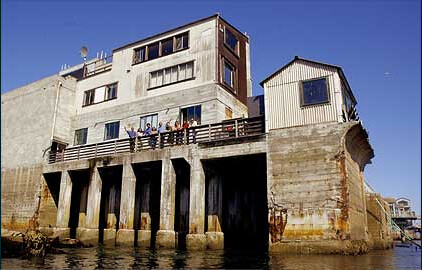
This shoot was especially exciting for me because I was brought on as the still photographer. This was the first time I had been on a crew where it was my sole responsibility to take photos. Normally, I am a PA (production assistant), so my job usually consists of doing whatever anyone tells me. Plus, I always take photos anyway. But this time I had the pleasure of focusing on just the photography. Also, someone hooked me up with a headset so I could listen in to all the production-speak. I am a scientist and a photographer by background, so the whole LA film scene was new to me. We had a 40 person + film crew this time. There were assistants for the assistants! Everything had to be perfectly choreographed so that we could film Edward Norton at all of the correct locations in the perfect light. We shot at a pier, a culvert, a fish market, a parking lot, a beach, and a water treatment plant.


Imagine getting that many people set up, tore down, and moved around in just two days. Kudos Brook!

Monday, August 6, 2007

Bronwen’s Road

July 29, 2007. Desert outside Swakopmund, Namibia.

When Namibia first gained its independence in 1990, the newly established fisheries Ministry had inherited a series of difficult challenges. For years, foreign fishers had been exploiting the rich fisheries off the coast with reckless abandon, ultimately depleting the stocks to devastating proportions. The Ministry set out a series of bold strategies to improve the stocks. Its ideas were progressive, science-based and testament to the spirit of the country's new constitution where sustainable use of resources is a cornerstone.

When Bronwen first arrived at the Ministry of Fisheries, her career path was clearly charted . . .

. . . she set out to study the near shore ecosystem, with a singular focus . . .

. . . but soon after her arrival, when she first learned of the hydrogen sulfide explosions, she veered off her immediate course, took a road less traveled and helped to address a mystery that many suspect needs to be considered in fisheries management -- the sulfide eruptions.

Welwitcha

July 27, 2007. Walvis Bay, Namibia.

For days, Kathy Peeard has been making miracles happen. She got us permission to film at the lighthouse in Swakopmund. She helped us scout locations at the Ministry, ran interference, greased wheels and basically made all of our jobs that much easier. Kathy and Bronwen even helped to arrange a special expedition on the research vessel Welwitcha. This was a great treat for all of us. For Mark Knobil and me, the experience brought back memories of more than a decade ago when we both set sail (twice) to film at the Titanic in the Atlantic. For Brook, who had just finished producing a series of specials focused on ocean conservation, it was a welcome change to the driving, flying and hiking we'd been experiencing for nearly a month.

The happy faces of Richard . . .

. . . Brook. . .

. . . Chad . . .

. . . Chris . . .

. . . Chad and David . . .

. . . Mark and Chad. . .
It was great to be out at sea!

Namibia Begins

July 24, 2007. Swakopmund, Namibia.

We started early this morning, and we had a lot to do. On the list:

1. Drop off laundry for cleaning (Brook, our Line Producer, had already made it clear that me, Mark, Chad and Chris were beginning to push the bounds of decency; in fact days earlier she insisted that we all shower before she would let us in the van from Kumasi to Accra.)

2. Meet the scientist whom we'd be filming. Up until this point, they'd all been voices over crackly phone lines.

3. Scout locations. We'd only seen pictures of Swakopmund and nearby Walvis Bay, and I for one had been scratching my head, and if truth be told waking up in cold sweats, trying to figure out how we were going to visualize this sequence. (More on this later.)

1. Laundry: Check.

2. Scientists: Check Plus!

Scarla Weeks, Andrew Bakun, Kathy Peeard, and Bronwen Currie (whom we'd meet later the next day) proved to be marvelous, each possessing a unique and charming personality. Scarla is a satellite oceanographer with exuberant charisma, who would later say in her interview that her office was in space. Andy is a big thinker, who occasionally quotes Shakespeare, and has the distinct good looks of a Hollywood actor. Kathy is both shy and bold; shy in the sense that she avoids the camera when given the chance, and bold to the extent that she became an invaluable member of our production team -- scheduling, scouting, approving shots and even on occasion making sure that our Director of Photography had his camera set properly. ("Mark," she asked during a lab shoot, "Is your extender turned off?")

And then there's Bronwen . . . I'd asked myself prior to meeting her, "Who is this woman on the other side of the phone with such a sweet voice, who patiently answers all of my questions (even the dumb ones)? In person, Bronwen is just as sweet as I imagined, and I would come to recognize that her patience and serenity is born of her love of the ocean. Bronwen is a surfer who spends as much time as she can in the water. She's also a biker, who peddles each day to and from the office. A beginning surfer myself, and a lifelong biker, I can attest to the peacefulness that these activities can bring, but in Bronwen her spirit had quite comfortably and unequivocally merged with her constant motion. Bronwen moves as if her feet barely touch the ground.

The excitement I felt upon meeting our scientists (and dropping off my laundry) was short lived. As we began scouting, it became painfully clear that we had less than twelve hours to reinvent an entire sequence that we had traveled half way around the world to shoot. And the clock was ticking.

Kathy and Bronwen discuss hydrogen sulfide, fish stocks, bacteria (and wonder what's for lunch.)

Scarla and Bronwen examining satellite images of Namibia's coastline.

Me and Andrew in the desert near Swakopmund.

Tuesday, July 31, 2007

Hello Namibia

July 23, 2007. Windhoek, Namibia.

After two long flights and a layover in South Africa, we arrived in Windhoek, Namibia feeling a bit whacked from the air travel and looking down the barrel of a five-hour drive. For all of us, Windhoek was a bit of a surreal experience at first. Perhaps it was the contrast to the hot, muggy and lush landscape of Ghana that took us off guard. Windhoek was dry and clear. We were surrounded by a vast expanse of desert and comforted by a cool breeze. The hustle and crowds of Ghana were gone, now replaced by a profound sense of isolation. "Where are we?" Chad, our assistant cameraman, asked in disbelief.

I think we were all experiencing a sense of being lost and trying to come to terms with this new location, which quite frankly didn't match up to any of our expectations. Mark Knobil, our Director of Photography, and Chris Strollo, our Soundman, (who have both worked extensively in Africa before) seemed a bit confused. For me, I think it was sensory deprivation. There was a single black road, beige sand (like some sort of lunar landscape) and blue sky. The only vestige of our Ghana experience was the baboons. There they were, seemingly larger, sitting on the side of the road like sentinels. It was strange seeing baboons out in the open among desert scrub brush. The baboons looked like dusty old books, sitting in lines along the side of the road.

As we drove into the night, our new colleague and driver ,AJ, answered periodic questions about the land, the people and the wildlife. The baboons in Namibia aren't a big problem though their numbers are growing. The giraffes we were seeing were part of game parks, a burgeoning new business. Hunting parks too were big. If you wanted to shoot a lion that could be arranged for 10K US, an elephant 25K and so on.

Late in the evening we finished crossing the desert and arrived in Swakopmund, which sits on the desert's edge of the coast. The town was eerily quiet, and the extremely wide streets, which were first built to accommodate ox carts, were devoid of any life. A thick blanket of fog covered the entire town, and it was very cold thousands of miles from Ghana, and even further from home.

Monday, July 30, 2007

Farewell Ghana (& the Big Headed Greenback)

July 22, 2007. Accra, Ghana.

This evening we loaded our gear for the last time in Ghana and were whisked off to the airport, lead once again by Teddy Sabutey, our fixer. At the airport, Teddy worked his magic for a final time and we breezed through customs and all the long lines at the airport. It was nothing short of miraculous. We did however run into one small obstacle that at first even stunned Teddy. When we went to pay for our excess baggage (we checked 19 bags), we were a bit shocked to discover that the airport doesn't take credit cards. Not to be shaken easily, Brook, our Line Producer, reached into her own magic bag and retrieved more than five hundred dollars in cash to pay the bill. Not so fast . . . To our surprise, our money was no good. The reason: our US currency was of the older variety, the kind where the President's portrait is smaller than that of the new currency. "We only take the Big Heads," the woman at the counter informed us.

We'd run into this problem before in Ghana. It was never really clear to me if the preference for big headed Presidents was born out of a fear of counterfeiting or simply just a penchant for big headed Presidents. It was hit or miss whether somebody would take your money. None the less, at the airport we were in a bit of the bind. We all scrambled for our wallets in a search for Big Headed Greenbacks. Fifty dollars here, one fifty there, eighty dollars in my own wallet. We came up very shy of Big Heads. We decided to make a dash for a money machine to retrieve Ghanaian bills, however there's a limit to what can be withdrawn (about the equivalent of $150 US per day). To complicate matters there were no machines to be found in our terminal, and the clock was ticking. We headed back outside and to another terminal, where Teddy worked his magic and got us through security and into the airport through an Exit Only door. Brook and Teddy headed inside, found no machines, but lucked into an Exchange booth. With a fist full of crisp, new Big Headed bills, we were on our way.
Teddy is without a doubt one of the best fixers in the world, and probably the best I've ever had the pleasure to work with. Whether it was getting us permission to shoot in a difficult location with hours notice, or running interference when we got ourselves in trouble, Teddy performed with grace, dignity and style.

After drinks at the bar, we killed some time with this garbage can. It performed its role well in a dramatic and powerful story filled with excitement, love, loss and the inevitable tragedy that so often unfolds when individuals follow their hearts.

The excitement and possibilities implicit in new love.
A chance encounter leads to romance . . .
. . . and ultimately to love.
With the passage of time, love reveals itself to be fleeting, and a distance is created until . . .
Betrayal.
The pain of a broken hearts.

Monday, July 23, 2007

The Heat Sets In

July 18, 2007. Mole National Park, Ghana

Although the weather in Mole has been unseasonably pleasant, it still can get very hot. Water here is also scarce and only runs a few times a day, and then only for a very short period -- maybe only an hour. Just when the water is going to run is anybody's guess. Each of us has two five-gallon buckets, which we try to keep full. These buckets are used for bathing and flushing the toilets, and we've all been very good about rationing and sharing water when necessary. It's a valued commodity, though it's not good for drinking. After arriving and shooting for a few days in Mole, a few of us have gotten sick, probably from the water. Whatever we had, it zapped strength and resulted in cramps and dizziness. We all running a little slower than normal, but I think we're capturing some beautiful images that will help shed light on an important story.

When rain calls a halt to the shooting, we take refuge in an air-conditioned room. On this day we were all thankful that we had electricity, and we took this opportunity to take a brief nap together. Ghana is in the midst of an energy crisis. The country relies on hydropower, and most of the major reservoirs are painfully low. As a result, there are countrywide rolling blackouts. Power is provided from the main grid in forty-eight hour cycles, so that places get two days of power and then are left on their own. Many rely on generators to make up for the days without power.

Baboons, Woman & Children

July 18, 2007. Mole National Park, Ghana

As much fun as they are to watch, we're really getting a sense of how much of a problem the baboons can be. One interesting thing that has been brought to our attention is that baboons don't seem to have any fear of women. In speaking to the workers of the park, this fact comes up again and again. In fact, recently just to test this hypothesis, a worker here dressed up as woman and mingled with the females working outside near the kitchen. When the baboons came by, as they do most evenings as dinner is being prepared, a few of them went about hassling the women and chasing them. When they approached the man dressed up in costume, they stopped dead in their tracks. They paused for a moment to give him a closer look. Once they realized that he was a man, they ran away to safety.

According to Brashares, baboons can also be incredibly aggressive. For instance, he reported one case in Kenya where he witnessed two male baboons attempting to take a baby from the arms of its mother. The baboons lunged repeatedly at the woman, bearing their teeth, barking and circling her. Confused and frightened, the woman was hysterical and didn't know what to do as the baboons got more brazen and aggressive. Finally, a man came to her aid and forced the baboons away.

These Patas monkeys, pictured below, can also be quite aggressive. One morning, when I was watching them, one looked up at me and then charged, swatting at me -- its arms flailing. I jumped back and tried to take a posture to scare him off, but he kept on coming. Finally, he backed away when a worker from the motel ran up with a slingshot. Moments later, the Patas raided our breakfast table as we sat. They jumped on the table, went right for the sugar and jam and stuffed their mouths full before darting off.

Chris's Special Evening

July 17, 2007. Larabanga, Ghana

After a full day of shooting, Chris, our soundman, stayed behind in Larabanga. His intention was to work with a Master drummer from the community, and he had high hopes of getting a private drumming lesson. To Chris's surprise and delight, rather than a lesson, the people in the community performed music from the Damba yam festival. This involves a complex drumming style of the same name. Chris points out that there's a dispute among musicologists as to how to count and notate this style of drumming. There are very few recordings of music from Northern Ghana, so the people of Larabanga fall into the cultural group known as the Gonja. This is a recording of drummers performing on the evening of a much-awaited thunderstorm. The group included a very old master drummer accompanied by several of the men who acted a hunters in the film. For Chris, the entire experience was magical, as it was only lit by lightening from the thunderstorm. Enjoy this rare recording courtesy of Chris!

Up Close With Elephants

July 16, 2007. Mole National Park, Ghana.

Early in the morning we set off with our guide, Samuel Anponsah Mensah, and headed into the park with the hopes of shooting elephants. We would not be disappointed. Samuel guided our vehicle down over the escarpment and into the alluvial plain. We passed through grasslands, and through the dense bush on a road that resembled a trail. After about a twenty minute drive, we took off on foot, and we didn't have to walk very far before meeting our first elephants taking their morning bath. As you might imagine, we were all thrilled to see these majestic animals at such a close range. For their part, the elephants didn't give us a second thought -- they lounged in the water, spraying, drinking and occasionally rough-housing.

There are approximately 800 elephants in Mole National Park, and unlike their distant cousins living in East Africa ( in places like Kenya) very little is known about these animals. Their groups have not been identified and none of them have been studied as individuals. The elephants of Mole present an incredible opportunity for any budding biologist looking to contribute to science.
Elephant footprints that have filled with water from rainfall the previous night.
Our Guide on this morning, Samuel Anponsah Mensah.
Elephants departing the watering hole stop to take a look at us before heading back into the bush.

Friday, July 13, 2007

Africa Shoot: Ghana Part 4

After the disappointment of the bush meat market, the fish market was a welcome success. We arrived on schedule and were greeted with cheers and applause. The entire Kumasi market was bustling with activity on a grand scale, and everywhere people were shoulder to shoulder. Among our crew, it was probably the most crowded place we have ever collectively shot. (I'm estimating that the market is about one square mile in size.) We followed our three lead scientists among the fish stalls as they recreated their survey work. The scientists were interested in investigating if the lack of fish in markets like Kumasi was fueling the bush meat trade. After years of work monitoring twelve markets in Ghana, they did saw a correlation: when fish supplies were down, the bush meat trade was booming, and when fish supplies were up, the bush meat trade appeared to wane.
Packed like sardines in a can, we made our way through the Kumasi market. This is probably one of the more difficult places I've ever had to shoot. Setting up shots, following our scientists and general communication were a big challenge.
The Queen Mother of the Fish Market. As you might guess from her smile, she was a delight. There are many Queen Mothers in the Kumasi market, and this one granted us permission to shoot in her domain.
Michael Afranie, Ghanaian film and television star, guided us through the markets. Everywhere we went, people cheered, applauded and reached out to touch him. He was a very cool guy.
Michael guides our crew through a labyrinth of stalls. Without his help we would have been lost in seconds.
One section of the Kumasi market, as seen from a an outdoor sewing factory. This was one of the only spots that we could find from above where you could actually see people because most of the market is packed so tightly.
A wider shot of the market. The market is all outdoors, with the vendors sitting under the shelter of metal roofs which obstructed any great wide shots.