Showing posts with label environment. Show all posts

Wednesday, September 30, 2009

Plastic Pollution Coalition

Wednesday, April 16, 2008

Television Premiere of Strange Days II


We are counting down the days to our broadcast premiere! Please join us by tuning in to PBS on April 23rd (Wednesday evening) to see "Dangerous Catch" and "Dirty Secrets".

Also check out our brand new interactive Strange Days PBS website: www.pbs.org/strangedays

Wednesday, January 30, 2008

Strange Days on Planet Earth Host Shoot


Well it finally happened...we filmed our host, Edward Norton in LA. We would have filmed him earlier in the month, but a freak storm put an end to that plan.

The second planned shoot went very smoothly. Our line producer, Brook Holston spent weeks working on the pre-production plans. We only had two days, but we managed to film all of the scenes starring Edward Norton for both new episodes of "Strange Days on Planet Earth". "Dirty Secrets" and "Dangerous Catch" will be premiering on PBS in April 2008 (the day after Earth Day).

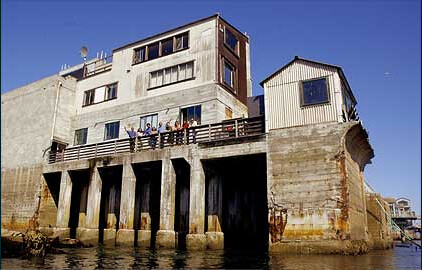
This shoot was especially exciting for me because I was brought on as the still photographer. This was the first time I had been on a crew where it was my sole responsibility to take photos. Normally, I am a PA (production assistant), so my job usually consists of doing whatever anyone tells me. Plus, I always take photos anyway. But this time I had the pleasure of focusing on just the photography. Also, someone hooked me up with a headset so I could listen in to all the production-speak. I am a scientist and a photographer by background, so the whole LA film scene was new to me. We had a 40 person + film crew this time. There were assistants for the assistants! Everything had to be perfectly choreographed so that we could film Edward Norton at all of the correct locations in the perfect light. We shot at a pier, a culvert, a fish market, a parking lot, a beach, and a water treatment plant.


Imagine getting that many people set up, tore down, and moved around in just two days. Kudos Brook!

Tuesday, July 31, 2007

Hello Namibia

July 23, 2007. Windhoek, Namibia.

After two long flights and a layover in South Africa, we arrived in Windhoek, Namibia feeling a bit whacked from the air travel and looking down the barrel of a five-hour drive. For all of us, Windhoek was a bit of a surreal experience at first. Perhaps it was the contrast to the hot, muggy and lush landscape of Ghana that took us off guard. Windhoek was dry and clear. We were surrounded by a vast expanse of desert and comforted by a cool breeze. The hustle and crowds of Ghana were gone, now replaced by a profound sense of isolation. "Where are we?" Chad, our assistant cameraman, asked in disbelief.

I think we were all experiencing a sense of being lost and trying to come to terms with this new location, which quite frankly didn't match up to any of our expectations. Mark Knobil, our Director of Photography, and Chris Strollo, our Soundman, (who have both worked extensively in Africa before) seemed a bit confused. For me, I think it was sensory deprivation. There was a single black road, beige sand (like some sort of lunar landscape) and blue sky. The only vestige of our Ghana experience was the baboons. There they were, seemingly larger, sitting on the side of the road like sentinels. It was strange seeing baboons out in the open among desert scrub brush. The baboons looked like dusty old books, sitting in lines along the side of the road.

As we drove into the night, our new colleague and driver ,AJ, answered periodic questions about the land, the people and the wildlife. The baboons in Namibia aren't a big problem though their numbers are growing. The giraffes we were seeing were part of game parks, a burgeoning new business. Hunting parks too were big. If you wanted to shoot a lion that could be arranged for 10K US, an elephant 25K and so on.

Late in the evening we finished crossing the desert and arrived in Swakopmund, which sits on the desert's edge of the coast. The town was eerily quiet, and the extremely wide streets, which were first built to accommodate ox carts, were devoid of any life. A thick blanket of fog covered the entire town, and it was very cold thousands of miles from Ghana, and even further from home.

Monday, July 30, 2007

Farewell Ghana (& the Big Headed Greenback)

July 22, 2007. Accra, Ghana.

This evening we loaded our gear for the last time in Ghana and were whisked off to the airport, lead once again by Teddy Sabutey, our fixer. At the airport, Teddy worked his magic for a final time and we breezed through customs and all the long lines at the airport. It was nothing short of miraculous. We did however run into one small obstacle that at first even stunned Teddy. When we went to pay for our excess baggage (we checked 19 bags), we were a bit shocked to discover that the airport doesn't take credit cards. Not to be shaken easily, Brook, our Line Producer, reached into her own magic bag and retrieved more than five hundred dollars in cash to pay the bill. Not so fast . . . To our surprise, our money was no good. The reason: our US currency was of the older variety, the kind where the President's portrait is smaller than that of the new currency. "We only take the Big Heads," the woman at the counter informed us.

We'd run into this problem before in Ghana. It was never really clear to me if the preference for big headed Presidents was born out of a fear of counterfeiting or simply just a penchant for big headed Presidents. It was hit or miss whether somebody would take your money. None the less, at the airport we were in a bit of the bind. We all scrambled for our wallets in a search for Big Headed Greenbacks. Fifty dollars here, one fifty there, eighty dollars in my own wallet. We came up very shy of Big Heads. We decided to make a dash for a money machine to retrieve Ghanaian bills, however there's a limit to what can be withdrawn (about the equivalent of $150 US per day). To complicate matters there were no machines to be found in our terminal, and the clock was ticking. We headed back outside and to another terminal, where Teddy worked his magic and got us through security and into the airport through an Exit Only door. Brook and Teddy headed inside, found no machines, but lucked into an Exchange booth. With a fist full of crisp, new Big Headed bills, we were on our way.
Teddy is without a doubt one of the best fixers in the world, and probably the best I've ever had the pleasure to work with. Whether it was getting us permission to shoot in a difficult location with hours notice, or running interference when we got ourselves in trouble, Teddy performed with grace, dignity and style.

After drinks at the bar, we killed some time with this garbage can. It performed its role well in a dramatic and powerful story filled with excitement, love, loss and the inevitable tragedy that so often unfolds when individuals follow their hearts.

The excitement and possibilities implicit in new love.
A chance encounter leads to romance . . .
. . . and ultimately to love.
With the passage of time, love reveals itself to be fleeting, and a distance is created until . . .
Betrayal.
The pain of a broken hearts.

Monday, July 23, 2007

The Heat Sets In

July 18, 2007. Mole National Park, Ghana

Although the weather in Mole has been unseasonably pleasant, it still can get very hot. Water here is also scarce and only runs a few times a day, and then only for a very short period -- maybe only an hour. Just when the water is going to run is anybody's guess. Each of us has two five-gallon buckets, which we try to keep full. These buckets are used for bathing and flushing the toilets, and we've all been very good about rationing and sharing water when necessary. It's a valued commodity, though it's not good for drinking. After arriving and shooting for a few days in Mole, a few of us have gotten sick, probably from the water. Whatever we had, it zapped strength and resulted in cramps and dizziness. We all running a little slower than normal, but I think we're capturing some beautiful images that will help shed light on an important story.

When rain calls a halt to the shooting, we take refuge in an air-conditioned room. On this day we were all thankful that we had electricity, and we took this opportunity to take a brief nap together. Ghana is in the midst of an energy crisis. The country relies on hydropower, and most of the major reservoirs are painfully low. As a result, there are countrywide rolling blackouts. Power is provided from the main grid in forty-eight hour cycles, so that places get two days of power and then are left on their own. Many rely on generators to make up for the days without power.

The day in the life of an AP in Africa

Brook Holston (Associate Producer)
July 17, 2007 Mole National Park, Ghana

Despite a giant thunderstorm yesterday, we are miraculously on schedule and have shot most everything that was planned and scheduled.

Justin Brashares, the scientist we are here with is a star and has been great on camera and a huge help all around. Justin's grad student, Cole Burton (also at Berkeley) is here and has been a huge help as well and we've been filming with him quite a bit.

I am currently in the town of Tamale, which is about 2 hours outside of Mole Park. Even though I came into "town", I am still chasing down one suitcase that's been missing since we arrived, which contains most of our tapestock. It should arrive here soon on a flight from Accra. As the "services" are limited at the Mole Motel, I'm also here making a supply run for things the hotel is low on or out of: fruit, water, fuel for our generator (as the power is quite random in Mole and battery charging has been a challenge), money changing, DHL (where I'm picking up tapestock that I ordered should the suitcase never makes it back to us), etc, etc!

So far the crew is doing great, although a bit tired, and the good news is all of our equipment has been working good in the heat and humidity. We are working closely with the Wildlife Division in Mole Park and they have been extremely helpful - yesterday we shot elephants and today will be shooting some Baboons. There are baboons at the Mole Hotel who are quite cheeky - they hang out right in front of your room hoping you'll drop your bag so they can have a look. Yesterday they stole a woman's backpack and she didn't get much back!!

Elephants and Cell Phones

July 15, 2007. Mole National Park, Ghana.

We're staying at the only overnight facility in Mole National Park, the Mole Motel. The motel is perched above a dam, and looks out across the countryside. The views are spectacular, and the dam looks more like a watering hole. Wart hogs have the run of the motel, and they can be seen everywhere. They kneel on their front legs eating every piece of greenery that they can find sprouting from the red dirt. Baboons, too, are very common and troops move through the park, swinging from trees, running through the dirt and bounding over the hill on their way to the water below. There are also lizards, big and small, that come in a multiple array of colors. When I see them, I can't help but think of my 10-year-old daughter, Zelda, who has become quite the lizard wrangler in Pacific Grove, California. However, of all the animals that I've seen thus far, the most surprising to me were the elephants.

This morning, I awoke around 5:30 in the morning, and I staggered out of bed to make breakfast by six. I checked my bathroom to see if the water was running (it wasn't, and would not run all day.) After that, I went out the back door of my room to look out over the valley below. As I stood on my porch, I heard the voice of Chad, who is rooming right next to me. "Elephants," he said, and pointed down toward the water. I rubbed my eyes and looked down the hill, and there they were: elephants. It was a group of five females and one young male standing in the water taking their morning bath. Just beyond them, in a stand of trees, stood a group of eight. It was an incredible sight and I took a seat to watch them. As I did, I have to admit that I felt very lucky to be in their presence, but at the same time the moment was tarnished by so many inescapable truths. Mole National Park, despite it's greatness, is under intense pressure of human development. Not far from the elephants, on the horizon to my left there was a cell phone tower. Like shoots of weeds, these towers are springing up everywhere, massive metal harbingers of the changes yet to come. Don't get me wrong, I think it's amazing that I can pick up my phone in the Ghanaian wilderness and call anywhere in the world, but this luxury comes with a price. "How long can these elephants last?," I wondered. " Will future parks like Mole become nothing more than large zoos?" For the people who know me, these questions come as no surprise. I no longer believe in the concept of "nature" as being a separate place, untouched by human hands. It's a myth, one often perpetuated by colleagues working in film, that there exists this vast untamed world. Yes, there are elephants and they should be revered and appreciated. Take the time to watch them and be humbled by their majesty. Feel honored to be in their presence, but keep your eyes on the horizon.

Below is a picture of the elephants from my bedroom in Mole National Park. We'd be getting much closer in the following days. After watching the elephants, and a cup of Nescafe coffee (which I have to admit, I'm starting to enjoy) we went to the nearby village of Larabanga, which has a population of approximately 4,000 people. The purpose of our trek was to meet with leaders from the local village to discuss our upcoming shooting plans. The meeting was held near one center of the village and was attended by the film crew, myself, and sixteen representatives from the village. A new guide named Eben served as a translator. After a morning prayer, we described our intentions and were warmly received.

Larabanga is predominantly Muslim, and most of the residents are farmers. Like the fisherman in Accra, the people here have to work a great deal in order to seek out a living. Their major crops are corn, groundnuts, yams and cassava, and they depend on rainfall to grow their crops; there is no irrigation. In addition to the fate of the rains, the farmers have to contend with elephants, which enter their fields from Mole National Park. Elephants can make short order of crops and destroy an entire harvest in a single morning. Monkeys are also major crop raiders. Of all the animals that the farmers have to contend with, though, perhaps the biggest threat, according to Justin Brashares, comes from the baboon populations. Their numbers in some places have increased by more than 600%. Brashares points out that while the villagers may be concerned most with the elephants, the data suggests that the baboons are the bigger problem.
Our morning meeting in Larabanga. The people of this community speak [Kamara], which is a language unique to this small town of 4,000 people.
The children of Larabanga were extremely beautiful and friendly. This young boy stood by my side, rubbing the hairs on my arm. He ultimately sat beside me, and held my hand, content to swing his feet back and forth, which dangled above the red dirt. The smile never left his face.